03 / Die-Cutting Capability
Die-cutting is not a finishing step.
It is where cost and yield are decided.
The cutting method you choose changes tooling cost, edge quality, scrap rate and lead time — often by multiples. We work across five methods precisely so the choice can be made on engineering merit rather than on whatever equipment happens to be idle.
Rotary Die-Cutting
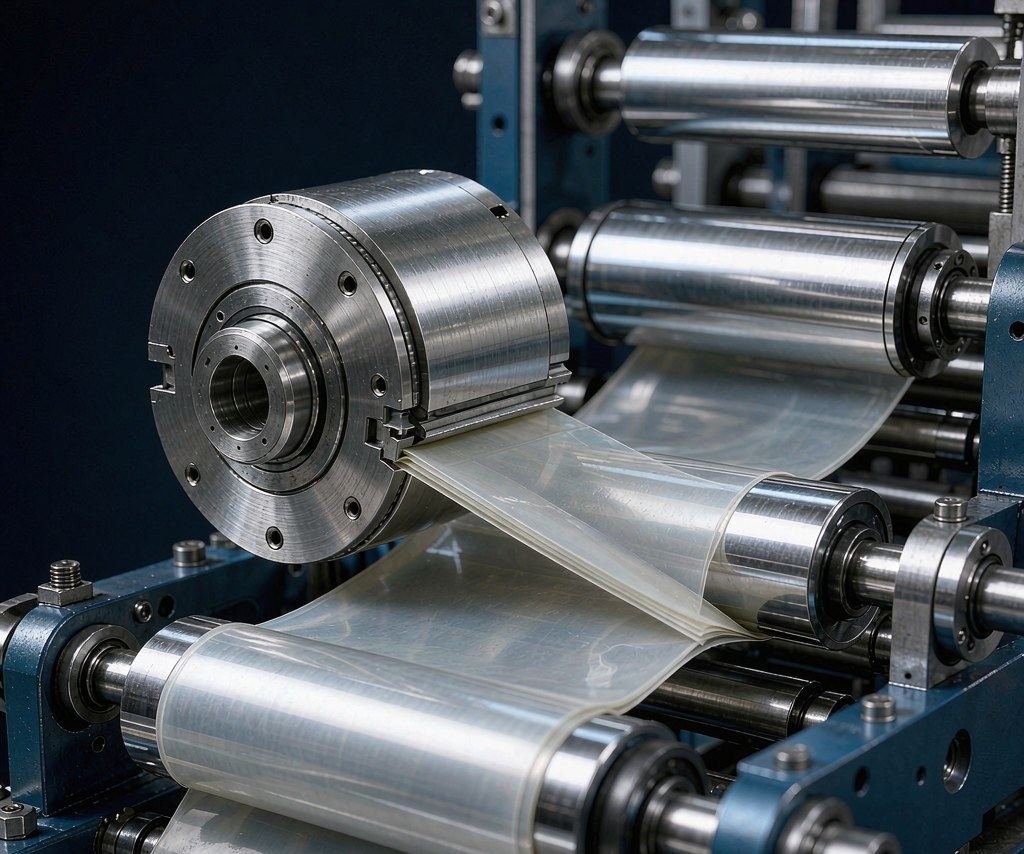
A cylindrical die cuts continuously as the web runs beneath it, synchronised to line speed. This is the highest-throughput method available for pressure-sensitive material, and the reason high-volume electronics and battery components are almost always rotary-cut. With register control it also holds multi-layer laminates in alignment through the cut.
- Best for
- High-volume roll-to-roll, thin to medium gauge
- Typical tolerance
- ±0.10 mm
- Line speed
- Up to 200 m/min
- Material range
- 0.03 – 1.5 mm
- Tooling
- Engraved solid cylinder or flexible magnetic plate
- Output format
- Kiss-cut on roll, matrix stripped, pick-and-place ready
Flatbed / Steel-Rule Die-Cutting
A hydraulic press drives a steel-rule die into stationary material. Because available press force is high and the die itself is inexpensive to build, flatbed is the practical choice for thick foams, stacked laminates and large or irregular shapes where a rotary tool would never pay back its cost.
- Best for
- Thick foam, multi-layer laminates, large parts
- Typical tolerance
- ±0.15 mm
- Material thickness
- 0.1 – 10 mm (stack cutting possible)
- Max sheet size
- 600 × 800 mm
- Tooling
- Steel-rule die — low cost, fast to build
- Output format
- Loose pieces, sheeted, or kiss-cut on liner

Laser Die-Cutting
A focused CO₂ or fibre beam vaporises material with no contact and no physical tool. There is nothing to wear, nothing to sharpen, and no minimum feature size dictated by blade radius — so intricate contours, very small inner radii and rapid design iteration all become viable. Beam parameters are tuned to keep heat away from the adhesive edge.
- Best for
- Complex contours, prototypes, fine features
- Typical tolerance
- ±0.05 mm
- Min inner radius
- 0.10 mm
- Material range
- Films, polyimide, PET, thin foams
- Tooling
- None — file straight to part
- Sample lead time
- Same day to 48 h

CNC Digital Knife Cutting
An oscillating or tangential knife driven by a CNC gantry cuts directly from a digital file. It bridges the gap between laser and steel-rule: no tooling to build, no heat input at the cut edge, and it comfortably handles thicker foams and rubbers that a laser would scorch or seal.
- Best for
- Prototypes, pilot runs, thick soft materials
- Typical tolerance
- ±0.15 mm
- Material thickness
- Up to 20 mm
- Bed size
- 1,600 × 1,200 mm
- Tooling
- None — knife path from CAD
- Sample lead time
- 24 – 72 h

Multi-Layer Composite Die-Cutting
Two to six layers laminated in register and then cut as a single part — adhesive, carrier film, foam, liner, even printed graphics. This removes assembly steps at your end: what arrives is one component with one part number that drops straight onto the line.
- Layers
- 2 – 6, laminated in register
- Registration accuracy
- ±0.15 mm layer-to-layer
- Typical build
- Adhesive + foam + film + liner
- Features
- Extended liner, peel tabs, split liner, perforation
- Best for
- Consolidating a sub-assembly into one part
- Output format
- On-liner in roll, sheeted, or kitted
Cut types & finishing features
Kiss-Cut
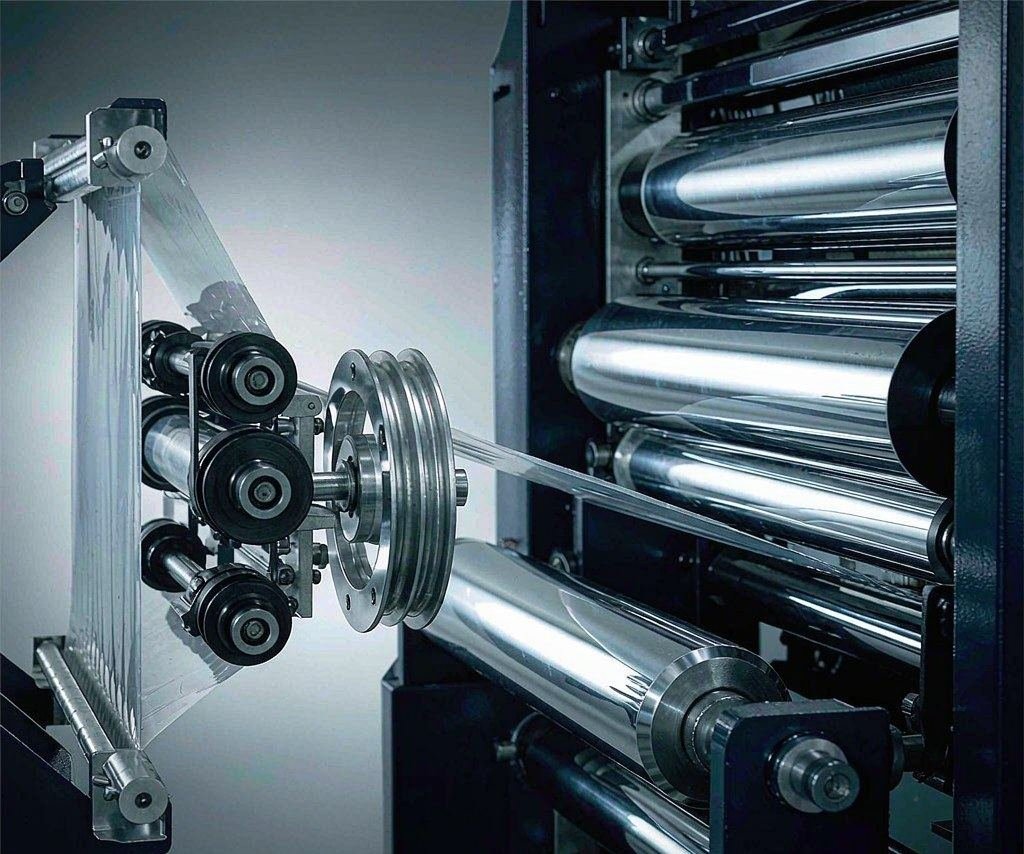
Cuts the face material and adhesive but leaves the release liner intact, so parts stay held on the liner and peel off cleanly one at a time. The standard format for line-side application.
Through-Cut
Cuts fully through material and liner to produce discrete, standalone parts. Used for gaskets, seals, spacers and any component handled individually.
Extended Liner & Peel Tab
A liner that projects beyond the part, or a dedicated finger tab, so operators can start the peel without tooling or fingernails. Small feature, large effect on assembly cycle time.
Nesting & Matrix Stripping
Parts nested to maximise yield from the web, with the surrounding matrix stripped away automatically. Directly reduces material cost per part — often the largest single saving available.
Our die-cutting methods are applied to customer-specified materials from all major manufacturers — including 3M, tesa, Nitto and Rogers — working to your supplied roll, drawing or part number rather than to any single brand's catalogue.