The Independent Advisor
Brand-agnostic by design. Because we do not own a coating line and are not bound to a single label, our recommendation carries no hidden agenda. We assess the application first and the price list second.

10+ Years in Pressure-Sensitive Adhesives
We do not manufacture tape and we are not tied to any single brand. That is precisely why our recommendation is worth something. We help engineers and buyers find the right adhesive solution — then convert it into exactly the part your line needs.
Where your specification calls for it, we also supply and precision-convert customer-specified materials from leading manufacturers — including 3M, tesa, Nitto and Rogers — with no claim of affiliation or authorisation. Brand names are trademarks of their respective owners.

01 / Our Role
Most suppliers sell you what they happen to stock. We start from what your application actually demands — substrate, surface energy, temperature window, load direction, service life — and then find the shortest, most economical path to it.
Brand-agnostic by design. Because we do not own a coating line and are not bound to a single label, our recommendation carries no hidden agenda. We assess the application first and the price list second.
Premium international grades are frequently over-specified for the job in front of them. We identify where the specification has margin to spare, then propose qualified alternatives that hold the performance you actually need at a materially lower landed cost.
A decade of relationships means access to allocated stock, legacy and discontinued grades, and early visibility into price movements. When your regular supply chain fails, we help you find a route fast.
| Compare on | Single-brand distributor | Tape manufacturer | DINGGU · independent partner |
|---|---|---|---|
| Range offered | One brand's catalogue | What their lines can coat | Multi-source, incl. premium and alternative grades |
| Recommendation bias | Tied to brand margin | Tied to own capacity | Tied to your application only |
| Cost optimisation | Discount negotiation | Volume-driven | Re-specification + right-sizing the grade |
| MOQ flexibility | Standard pack sizes | Coating-run minimums | From pilot quantity upward |
| Converting & die-cutting | Usually outsourced | Roll formats first | Five die-cutting methods, chosen on merit |
| If supply is disrupted | Wait for the brand | Wait for the line | Cross-qualified alternates already mapped |
02 / Product Families
We describe materials by what they do and how they are built, because that is how they should be selected. Tell us the job and we will map it to a construction — including the premium international grade, where that is genuinely the right answer.
Beyond our own-qualified constructions, DINGGU also supplies and precision-converts materials from leading international tape manufacturers — including 3M, tesa, Nitto and Rogers — to your specified part number, to your drawing, or qualified as an equivalent. Our die-cutting and converting processes are applied to customer-specified materials from these and other brands on the same engineering basis as our own range.
Brand names are trademarks of their respective owners. References here are for material identification only and do not imply any affiliation, authorisation, agency or endorsement by any brand owner. See the trademark notice in the footer.
Tissue, PET, PE and film-carrier constructions with acrylic, rubber or modified-acrylic adhesive systems. The everyday workhorse for nameplates, trim, gaskets and component fixing.
Viscoelastic acrylic foam cores that replace screws, rivets and welds. Distributes stress across the joint, absorbs differential thermal expansion, and seals in the same operation.
Thermally conductive adhesive tapes, gap fillers, graphite heat-spreading sheets and thermal pads for moving heat out of dense, sealed assemblies without adding fasteners.
Copper and aluminium foil tapes with conductive or non-conductive adhesive, plus conductive fabric-over-foam, for grounding, shielding continuity and static dissipation.
Polyimide, polyester, PTFE glass cloth and aramid paper tapes for solder masking, slot liners, hairpin winding insulation and elevated-temperature class duty.
Microcellular polyurethane, silicone, EPDM, EVA and polyethylene foams in open- and closed-cell forms — die-cut into cushioning pads, dust seals, compression gaskets and NVH parts.
PE, PET and paper protective films from low to medium tack, for coating, forming, machining and transit protection — engineered to remove cleanly without residue or ghosting.
Optically clear adhesives, light-shielding and black-white double-coated tapes, diffuser and reflector films for backlight units, bezels and display module assembly.
Adhesive systems engineered for low-surface-energy plastics, powder-coated, textured and lightly oiled surfaces — plus removable, repositionable and high-shear constructions.
3M industrial and specialty tapes supplied and converted to your part number. From VHB structural tapes to electrical, masking and thermal management grades, processed with the same tooling and quality controls as our own-qualified constructions.
tesa adhesive tapes for automotive, electronics and industrial assembly. Supplied to your specified tesa part number and die-cut or converted into pads, strips, liners and custom shapes to your drawing.
Rogers BISCO silicone foams and PORON microcellular urethanes for gasketing, sealing, cushioning and compression-set resistance. Converted from your specified Rogers grade to tight-tolerance parts.
Material families are described generically by construction and function. Where your drawing already specifies a particular international grade, send us the part number and we will quote both that grade and a qualified alternative side by side.
03 / Die-Cutting Capability
The cutting method you choose changes tooling cost, edge quality, scrap rate and lead time — often by multiples. We work across five methods precisely so the choice can be made on engineering merit rather than on whatever equipment happens to be idle.
A cylindrical die cuts continuously as the web runs beneath it, synchronised to line speed. This is the highest-throughput method available for pressure-sensitive material, and the reason high-volume electronics and battery components are almost always rotary-cut. With register control it also holds multi-layer laminates in alignment through the cut.
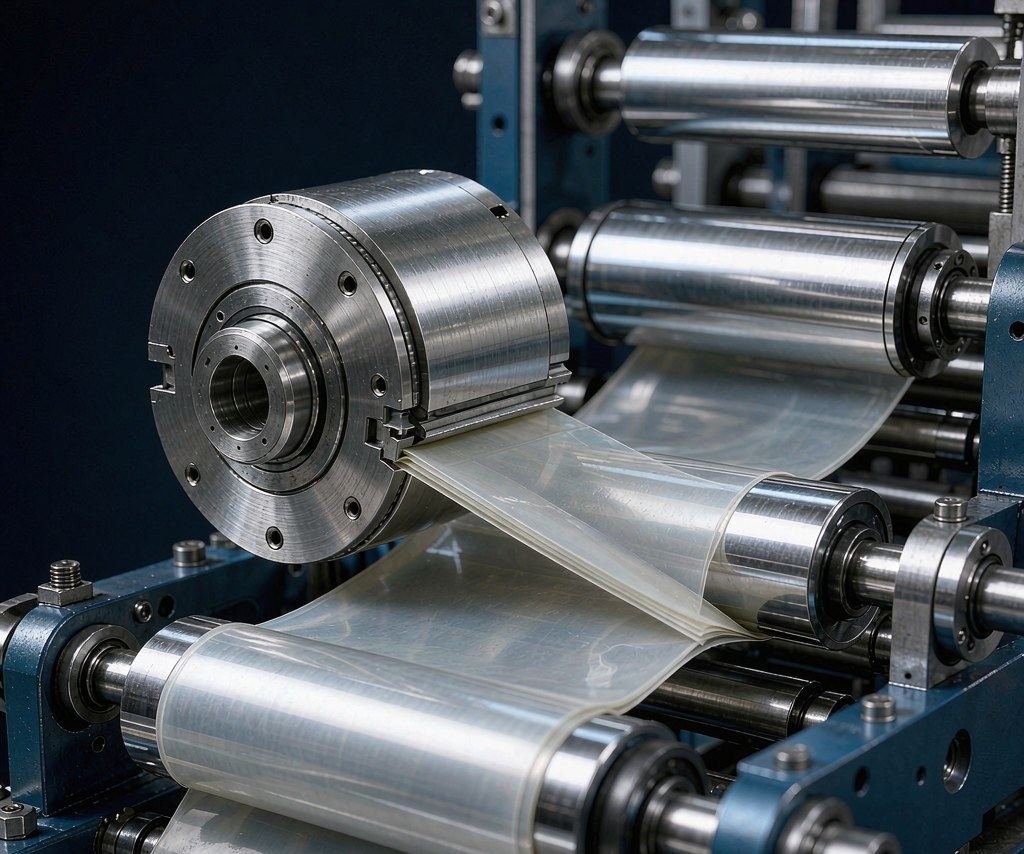
A hydraulic press drives a steel-rule die into stationary material. Because available press force is high and the die itself is inexpensive to build, flatbed is the practical choice for thick foams, stacked laminates and large or irregular shapes where a rotary tool would never pay back its cost.

A focused CO₂ or fibre beam vaporises material with no contact and no physical tool. There is nothing to wear, nothing to sharpen, and no minimum feature size dictated by blade radius — so intricate contours, very small inner radii and rapid design iteration all become viable. Beam parameters are tuned to keep heat away from the adhesive edge.

An oscillating or tangential knife driven by a CNC gantry cuts directly from a digital file. It bridges the gap between laser and steel-rule: no tooling to build, no heat input at the cut edge, and it comfortably handles thicker foams and rubbers that a laser would scorch or seal.

Two to six layers laminated in register and then cut as a single part — adhesive, carrier film, foam, liner, even printed graphics. This removes assembly steps at your end: what arrives is one component with one part number that drops straight onto the line.
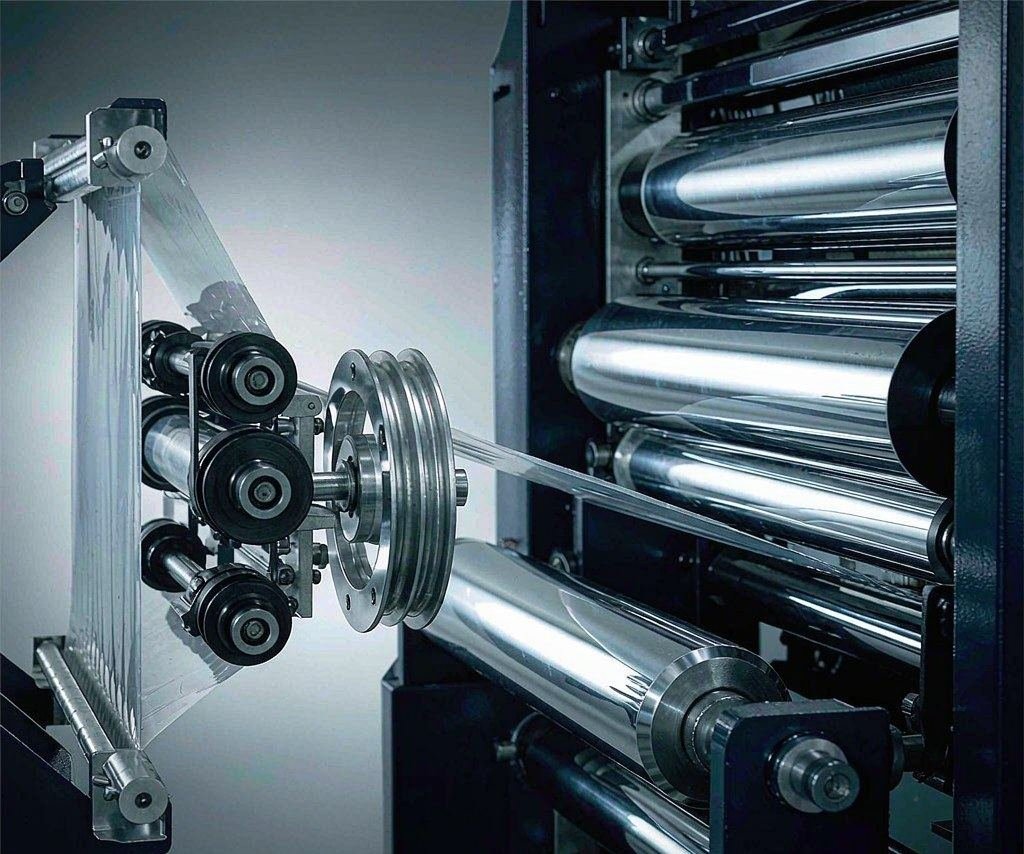
Cuts the face material and adhesive but leaves the release liner intact, so parts stay held on the liner and peel off cleanly one at a time. The standard format for line-side application.
Cuts fully through material and liner to produce discrete, standalone parts. Used for gaskets, seals, spacers and any component handled individually.
A liner that projects beyond the part, or a dedicated finger tab, so operators can start the peel without tooling or fingernails. Small feature, large effect on assembly cycle time.
Parts nested to maximise yield from the web, with the surrounding matrix stripped away automatically. Directly reduces material cost per part — often the largest single saving available.
Our die-cutting methods are applied to customer-specified materials from all major manufacturers — including 3M, tesa, Nitto and Rogers — working to your supplied roll, drawing or part number rather than to any single brand's catalogue.
04 / Converting Capability
Eight core operations, sequenced so the material is handled as few times as possible. Fewer handovers means less contamination, less tension damage and tighter dimensional control by the time it reaches your line.
Full-width master rolls supplied directly from coating partners, for customers who run their own converting lines and simply need reliable material and a stable price.
Log slitting and lathe slitting down to narrow widths with clean, dust-free edges, no telescoping and no adhesive ooze on the cut face.
Re-tensioned, re-cored and length-controlled rolls, with core ID and roll length set to match your dispenser or applicator rather than the mill's default.
Roll stock converted into sheets or fixed-length strips, interleaved, stacked or counted into packs — ready for manual application or sheet-fed automation.
Adhesive-to-substrate, foam-to-film and multi-layer builds, with corona treatment applied where surface energy would otherwise limit adhesion.
Rotary, flatbed, laser, CNC knife and multi-layer composite cutting across a coordinated partner network — so method is chosen by geometry and volume, not by availability.
Custom printing on tape face or liner, branded cores, printed peel tabs, and fully private-label cartons and labels — your identity on the part and on the box.
Bagged, carded, interleaved or kitted by assembly station, then barcoded and labelled to your ERP format so goods-in never has to relabel anything.
Controlled-environment converting available for optical and display work, with particle-conscious handling, lint-free gloving and protective interleaf on request.
These converting operations are carried out on customer-specified materials from all major tape manufacturers — including 3M, tesa, Nitto and Rogers — whether supplied by you or sourced to your part number.
05 / Application Industries
Temperature cycling, chemical exposure, vibration spectrum, cleaning regime and expected service life all change what "good adhesion" actually means. These are the sectors we work in most often, and the failure modes we watch for in each.
Bonding, shielding, cushioning and insulating inside assemblies where every tenth of a millimetre is contested.
Cell, module and pack materials selected for electrical, thermal and long-term creep duty.
Fastener replacement, sealing and vibration control across body, trim and cabin.
Bonding and sealing across metal, glass and coated plastic, with cleaning-agent resistance in mind.
Optically matched bonding and light management, where a single particle is a reject.
Skin-contact and device adhesives with documented material routes and traceable lots.
Gasketing, protection and maintenance-grade bonding for equipment built in small series.
Weather-durable bonding built for a twenty-year outdoor service expectation.
Clean-edge mounting and repositionable systems where the finished surface is the product.
Lightweight bonding, damping and thermal barriers for interiors built to long duty cycles.
06 / Company Strength
Three questions decide whether a materials partner is actually usable in practice: will they take your quantity, can they prove the material, and can they still deliver when one factory goes down. Here is our answer to each.
Pilot batches, first articles and design-validation runs are accepted at genuinely low quantity. You should not have to buy a year of inventory to find out whether an idea works. Once the design is frozen, volume pricing follows.
We work across multiple ISO 9001 and IATF 16949 certified coating and converting partners, with overlapping qualification on the materials that matter most. One factory's downtime does not become your line stoppage.
Technical enquiries answered within one working day. Formal quotation within 48 hours. Samples typically dispatched in three to seven days, and production in seven to fifteen depending on tooling.
Materials are verified against recognised ASTM, ISO, PSTC, AFERA, FINAT, JIS and GB test methods before we put them in front of you — and again on each qualification lot. Reports are issued with the material.
Measures the force required to remove tape from a standard test panel at controlled speed and dwell time. The primary check on adhesion consistency between lots.
ASTM D3330 · ISO 29862 · PSTC-101Quantifies instantaneous grab on first contact with no applied pressure — the property that decides whether a die-cut part stays where the operator placed it.
ASTM D6195 · AFERA 4015 · FINAT 9Inclined-track measurement of initial tack, giving a fast, repeatable comparison between adhesive batches during incoming inspection.
ASTM D3121 · PSTC-6Static load applied in shear at controlled temperature to measure time to failure. The most honest predictor of long-term creep behaviour under load.
ASTM D3654 · PSTC-107 · GB/T 4851 · JIS Z 0237Backing tensile strength and elongation at break, plus T-peel, lap-shear and floating-roller configurations through interchangeable fixtures.
ASTM D3759 · ASTM D882 · ASTM D1876Verifies that rolls pay off smoothly at production speed. After a supplier change, unwind force is the single most common cause of unexpected line stoppage.
ASTM D3811 · FINAT 3Contact micrometer for total construction thickness and adhesive coat-weight verification, sampled across the web width to catch profile drift.
ASTM D3652 · ISO 534Accelerated ageing under controlled heat and humidity to confirm that adhesion is retained across the full service window, not just on day one.
IEC 60068-2-78 · ASTM D4332Rapid cycling between temperature extremes to expose delamination, embrittlement and adhesive migration long before the customer's field does.
IEC 60068-2-14 · ASTM D3330 (aged)Simulated sunlight, heat and moisture exposure for any material facing an outdoor, backlit or window-adjacent service life.
ASTM G155 · ISO 4892 · ASTM G154Corrosion resistance of foil tapes, conductive constructions and bonded metal joints — essential wherever a conductive adhesive meets a dissimilar metal.
ASTM B117 · ISO 9227Optical dimensional verification of die-cut geometry — inner radii, hole positions, web widths and edge burr — used for first-article and in-process checks.
First-article & in-process inspectionConfirms substrate wettability before adhesive selection. It is the step most often skipped — and the reason a large share of bond failures happen at all.
ASTM D2578 · ISO 8296Static and kinetic friction of liners and films — directly relevant to automated dispensing, pick-and-place reliability and stack handling.
ASTM D1894 · ISO 8295Certifications listed above are held by our manufacturing and converting partners. DINGGU Tape coordinates qualification, testing and documentation across that network — certificates for the specific mill supplying your material are provided on request.
07 / Our Story
It's too expensive for us to use. Is there anything similar we could use instead?— The question we heard for ten years
For more than a decade our work was specifying and supplying premium international adhesive systems to electronics, appliance and automotive customers. Good materials. Genuinely good — the performance data is real and, in demanding applications, entirely worth the price.
But the sentence we heard most often was not a technical question. It was a budget one. And for a long time the honest answer was an unsatisfying "not really" — because the alternatives we knew of were either unproven, inconsistent between lots, or simply nobody had tested them properly against the grade being replaced.
So we spent years fixing that. Testing domestic Chinese coatings against the same methods the premium grades are measured by. Finding which mills hold tolerance and which only claim to. Learning where a specification has real margin to spare — and, just as importantly, where it does not and you should absolutely pay for the original.
DINGGU Tape is the answer to that question. Honest, brand-agnostic advice. Flexible volumes. Fast response. Precision converting and die-cutting. And premium international grades still available whenever they are genuinely the right engineering answer — because our job is to serve your project, not to defend a catalogue.
Years spent specifying and reselling premium international adhesive systems. Enough repetition across enough applications to learn where each construction genuinely earns its price — and where it quietly does not.
Systematic evaluation of domestic coating and converting capability. Which mills hold tolerance. Which adhesives survive accelerated ageing. Which claims collapse the moment they meet a shear rack.
Qualification of multiple ISO-certified partners across rotary, flatbed, laser and CNC knife die-cutting — so that cutting method could finally be chosen on engineering merit rather than on what one factory happened to own.
Unbiased recommendations backed by measurement, low minimum quantities, a redundant supply base, and die-cut parts that arrive ready for the line.
08 / Frequently Asked
No, and we say so openly. We do not own coating lines. We are an independent materials partner and converter: we select and qualify material, then convert it into the part you need through a network of ISO-certified manufacturing partners. Not owning a coating line is exactly what allows our recommendation to be neutral.
No. We hold no distribution authorisation, agency or endorsement from any tape manufacturer, and we do not claim any affiliation. Our team's decade of hands-on experience with leading international brands is professional background — it is not a commercial relationship with them. Any brand name we mention refers only to that experience or to material you already specify.
Sometimes yes, sometimes no — and we will tell you which. The honest framing is this: premium grades are engineered with margin for the hardest version of an application. If your application is not the hardest version, that margin is cost you are paying for and not using.
Our method is to establish what performance the application genuinely requires, then test candidates against the same methods used to characterise the original:
Where an alternative does not hold up, we say so and quote the original. A substitution that fails in the field costs far more than the material ever saved.
For die-cut parts, typically from around 100 pieces for prototype and validation work, depending on geometry and material. For roll goods it depends on slit width and the master roll involved. Tell us your quantity and we will tell you straight away whether it is workable — and if a laser or CNC knife route avoids tooling cost at your volume, we will propose that instead.
The more of the following you can give us, the faster and more accurate the answer:
If you only have a drawing and a rough idea, that is still enough to start. We will ask the rest.
Yes. Where a premium grade is genuinely the correct engineering answer — or where your customer's specification mandates it and cannot be changed — we source it and convert it for you. Our value is not "always cheaper". It is "always the right call, explained". Frequently the best outcome is a premium grade in the critical joint and an alternative everywhere it was over-specified.
Typical timings, subject to material availability and geometry:
It depends on method and material, and anyone quoting a single number for everything is guessing. Laser typically holds ±0.05 mm. Rotary with register control typically ±0.10 mm. Flatbed and CNC knife typically ±0.15 mm. Soft, thick and highly compressible foams are inherently looser than thin films. Send the drawing with its tolerance callouts and we will confirm what is achievable before you commit — and tell you if a tolerance is unnecessarily tight for the function.
This is one of the situations we are most useful in. Long relationships across the industry mean we can often locate remaining allocated or legacy stock to bridge you through, while we qualify a permanent replacement in parallel. Send the discontinued part number along with the application details and we will pursue both routes at once.
Technical data sheets, certificates of analysis and conformance, RoHS and REACH declarations, dimensional inspection reports for die-cut parts, and test reports for the specific properties agreed during qualification. First-article inspection documentation is available on request, and we can align report formats to your incoming-inspection requirements.
Yes, gladly, and before you send drawings if you prefer. We work with product designs that are not yet public and treat every drawing, specification and volume figure as confidential by default. We will also never use your company name as a reference without written permission.
Transparently and separately from the part price, so you can see exactly what you are paying for. Laser and CNC knife require no tooling at all. Steel-rule dies are inexpensive and quick to build. Rotary cylinders cost more but amortise fast at volume — and we will show you the break-even point rather than simply steering you to the tool with the higher margin. Existing dies in the network are used wherever your geometry allows.
09 / Contact Us
No call centre, no ticket queue. Your enquiry is read by someone who has spent ten years specifying these materials and will answer with an engineering opinion, not a catalogue page.